Tuesday, October 12, 2010

Consequences of Industrialization

We all know that industrialization has added to our world in a positive way: the ability to to produce products in a fast, efficient, and cheaper way, the ability to mass produce medical products and drugs that increase life expectancy, more leisure time, etc..  Industrialization has had negative consequences on our world as well.  Pollution and global warming are only two of the very serious problems that have been laid on our laps to solve by industrialization.

In partners choose one of the topics below.  Watch the video and then do a little research on the topic.  Prepare a 5 minute presentation (you may show the video but that doesn't count towards the 5 minutes) on your topic.  Answer the 5 Ws and one H - who, what, where, when, why and how.  Give any information that you think is important.  Post your information on your blog.  In addition to the information, pose two questions that should get your readers thinking about the information and that they can respond to.

BP Gulf Oil Spill


                              Hungary Toxic Sludge Spill

  Coal Burning and Acid Rain


   Union Carbide Bhopal Disaster

  Minamata Disease 

                             Chernobyl Nuclear Disaster

                                       The Killer Fog of London 1952   

                                          Love Canal

                                      Baia Mare Cyanide Disaster

    Three Mile Island Nuclear Disaster

                                 Exxon Valdez Oil Spill

                                      Alberta Tar Sands

                                  United Kingdom BSE Crisis

                                      The Disappearing Aral Sea


                                Plastics in the Environment - The Great Pacific Garbage Dump


                                   Seveso Disaster

                                   Chilean Miners Freed

Thursday, October 7, 2010

Cottage Industry vs Industrialization

Cottage Industry:
  • In the 1700s the primary way of making one's living was by farming
  • At least 75% of the British population were farmers
  • In the winter-time people had a lot of time on their hands so they would keep themselves busy with activities like weaving, knitting, candle-making, etc.
  • This allowed farmers to add to their income, and provided products for urban merchants to sell - it was a win-win situation
  • The cloth merchants would travel around the countryside to buy wool which he then would distribute to farming households in the winter to card, spin and weave into cloth.
  • The merchant would then return at several points during the winter to pick up the cloth.

Industrialization
  • Because of the Agricultural Revolution, farm labourers who had lost their work moved to the cities looking for jobs.
  • New inventions allowed products to be produced faster and more efficiently and at less cost.
  • These inventions also allowed faster transportation and communication.
  • Changes in the banking system to private banking, and changes in laws to free up money and commerce allowed businessmen to finance factories and business ventures.
  • There was little understanding about what the pollution produced would do to the environment over time.
 
  • The unemployed farm labourers began to move to the cities to work in the factories that began to spring up.
  • The population of the cities in Britain began to grow astronomically.
  • The population of London grew from 1/5 to ½ the total population of Britain.
  • The cities were not prepared to handle such a rapid growth in population.
  • Single rooms were often rented to a whole family, or sometimes several families.
  • These rooms had no running water or toilets.
  • Whole neighbourhoods had to share one hand operated water pump and a couple of outdoor toilets.
  • Human waste was dropped into sewers that ran down the centre of streets.
  • Garbage was tossed into the streets.
  • The dirty, overcrowded conditions caused the spread of diseases like typhus, cholera, tuberculosis, smallpox and dysentery.
  • In 1832, in London alone 31,000 people died of cholera.
  • Chimneys, bridges and factories, as well as the smog from burning coal, blocked out most of the light in the poor sections of the city.

  • Social Change and Charles Dickens:

    Many people in the new middle class that arose during the Industrial Revolution were concerned with the conditions of the poor and working class.  One such person was the writer Charles Dickens.  He wrote stories in serial form for the newspapers - one chapter per week - and they were eagerly read by the people of London.  His stories were always about the social ills of Victorian England, particularly London.  Perhaps his most famous tale is A Christmas Carol.  Other books include Oliver Twist, Great Expectations, A Tale of Two Cities, David Copperfield, and others.  

    Watch the movie "A Christmas Carol".  Think about the following as you watch:
    • How is the concept of mercantilism represented?
    • What do you think Dicken's attitude to the Poor Law, debtor's prison and the workhouses was?
    • What changes do you think Dicken's wanted to see?
    • Do you think he was successful in bringing about change?

Wednesday, October 6, 2010

The British Agricultural Revolution


British Agricultural Revolution
  • took place in the late 18th and early 19th centuries
  • changes in agricultural practices resulted in tremendous increase in productivity
  • the agricultural revolution resulted in growth of population and freeing up the labour force
  • there were four main changes in agricultural practices: enclosure, mechanization, four field crop rotation, and selective breeding

Enclosure
  • prior to the 18th century, farmers used the open-field system.  
  • farmers subsistence-cropped on strips of land in 3 or four large fields held by the feudal land owner.
  • these peasant farmers used common land to graze livestock
  • enclosure farming enclosed fields for common use - this made farming more efficient but took the common areas away from the peasants
  • When the small scale farmers had to pay for their land to be resurveyed they often couldn't afford the costs and were forced to sell their land, often for much less than it was worth.

Mechanization
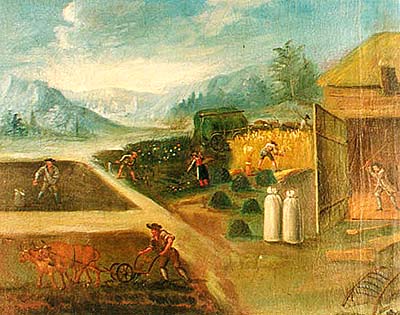
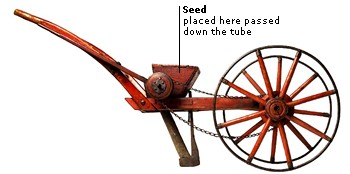
  • certain inventions made a huge difference to the efficiency of farming - these inventions included Jethro Tull's seed drill, the Rotherham iron plough and the Scot's iron plough, and Andrew Meikle's threshing machine.

Crop Rotation
  • initially this was a three field rotation - two fields were planted with different crops (i.e. wheat and barley) and the third was left fallow, or empty, allowing the third field to replace minerals and nutrients that had been taken by the crops previously planted
  • later, it was discovered that growing legumes in the fallow field helped to restore nitrogen
  • eventually it was discovered that a four field rotation was more efficient than a three field system
  • because the fields had better nutrients the crops were better
  • this improved the diet of both people and livestock
  • more and better livestock were kept which meant better and more manure which helped to grow better crops

Selective Breeding
  • by breeding animals that had desirable qualities, quality of livestock began to improve

Effects on History
  • this was a major turning point in history
  • the increase of the population of Great Britain was able to be sustained due to better farming techniques and increased production of crops
  • early in the agricultural revolution a new class of landless labourers developed leading to a growth in the cottage industries
  • women had worked side by side with their farmer husbands, however the new iron ploughs were too heavy and women were relegated to other work, often taking part in cottage industries to supplement the farming income
  • other women were forced into domestic services or prostitution

Tuesday, October 5, 2010

A Question of Loyalties - Part 2

Watch the end of "A Question of Loyalties" and answer the following questions:

1.     Against who else did the British go to war? During the French Revolution, the British and the French went to war against each other.
2.     What was the French Canadian response to the guillotining of Louis XVI? The French Canadians were horrified that the French had guillotined their king.  They felt in many ways tied to the British while still holding tight to their culture, language and religion.
3.     What was the British response in regard to the French Canadians? The British felt that the French Canadians were analogous to the French - they did not see that the French Canadians felt close to the British, they assumed that the French Canadians would fight against them given half the chance.
4.     Two newspapers were established – one in Upper Canada and one in Lower Canada.  Why were the British so afraid of what was printed in the papers? 
5.     Why was Canada particularly vulnerable.
6.     Who was Tecumsah?  Why did he ally with the British? 
7.     Who was James Madison?  What did he do?
8.     How did General Brock manage to take Fort Detroit? 
9.     What happened later on the Niagara River?  Which group was critical in holding back the Americans?
10.  How did the Americans view Tecumsah?
11. Why did the British abandon Fort Detroit?  What was Tecumsah’s response?
12.  Compare General Proctor, General Brock and Tecumsah as military leaders.
13.  Why did the Americans feel they must attack Montreal?
14.  What was the result of the two American attacks on Chateauguay?
15.  Who was Joseph Wilcox?  Why were the British so interested in him?  What made him so dangerous to Canada?
16. What happened at Lundy’s Lane?  

Monday, October 4, 2010

Canada: A People's History - A Question of Loyalties

CANADA: A PEOPLE’S HISTORY
A QUESTION OF LOYALTIES


As you watch the film answer these questions.  Since there are quite a few questions, you may want to work with a partner and divide the questions between you.

1.     What does it mean when the narrator says that the Americans were at war with themselves?  The rebel Americans were attacking the Loyalists.
2.     Why did the rebels approach Quebec?  What was the response? They were sent an open letter "asking" them to join the American rebels.  Part of the the request was a veiled threat.  While there were some of the French who secretly hoped the rebels would over-throw the British, most felt that it was just infighting within the British 13 colonies.
3.     What does the expression “the shot heard ‘round the world” mean? This marked the beginning of the Revolutionary War.
4.     How did most Canadians view the war between the British and the American rebels and how did the Canadians’ response to the call to arms reflect this? See the answer to question 2.  The call to arms fell mainly on deaf ears.  The British forces had difficulty getting any of the French Canadians to sign up to fight the rebels. 
5.     What was the American plan to invade Canada? One garrison of rebels would head north towards Montreal and the other garrison would loop to the East and come down the St. Lawrence to Quebec.
6.     Describe what happened at Fort St. Jean.  What city was left unprotected? The British in Fort St. Jean stood against the rebel forces, however they were greatly outnumbered.  Eventually they had to surrender.  This left Montreal unprotected and the rebels marched into Montreal as soon as Fort St. Jean had fallen.
7.     What factors make the defense of Quebec City “doubtful”? The British continued to have difficulties in getting the French Canadians join the British forces.  In addition, there was one group of rebels marching toward them from Montreal and another coming down the St. Lawrence.
8.     What allowed Carleton to save Quebec City? Carleton threatened to evict any man - French or otherwise - from Quebec City if they refused to join the British forces.  Also, a rebel deserter came to the British and told them that the rebel forces planned to attack on the first snowy night.  This occurred on New Years Eve.  Because of the snow, when the rebels coming from Montreal attacked, they didn't see the British waiting for them and their leaders were all slaughtered.  This allowed the British to corner the other rebels and eventually the rebels surrendered.
9.     Who were the Loyalists?  What happened to them? The Loyalists were members of the 13 colonies (Americans) who were still loyal to the British crown.  The rebels took all their supplies and put their men in prison, leaving the women and children to freeze and starve in the winter.
10.  Who were Butler’s Rangers? These were Loyalists who joined with the British to make a crack fighting team to help to try to defeat the rebels. How did the Revolutionary War become a civil war? The rebels turned on the Loyalists even though both groups were Americans.
11.  Who was Joseph Brant?  Also known as Thayendanegea, he was a military and political leader of the Mohawks.  What message did he take to King George?  He promised George III that the six Iroquois nations would fight on the side of the British if the British would protect Iroquoian land.  What message does he take back to Canada? George III agreed to Brant's proposal.
12. What response do the Iroquois have to Joseph Brant’s deal? Three of the nations side with the British but the other three side with the rebels.
13.  What were George Washington’s orders in regards to the Iroquois?  He ordered the rebels to burn the Iroquoian villages.  What were the results of these orders? All the Iroquois nations had to flee north into Canada.
14. Other than the Loyalists and the Six Nations, which other group migrated to Canada? African Americans.
15. What impact did the Loyalists have on Nova Scotia?  So many Loyalists came to Nova Scotia from New York that they quadrupled the population.  What conditions did they live under that first winter? Many spent the winter in tents.  Food was scarce.
16. What difficulties did the black Loyalists face in their new home? They had difficulties finding work as the white Canadians felt that jobs should not be given to the black Loyalists over the whites.  In spite of this, most stayed and settled and tried their hand at farming.
17. What part of Canada was the “upper country”? Ontario Who settled it? Butler's Rangers moved into the rougher parts of the "upper country".
18. Who was forgotten in the treaty between the British and the Americans?  Why was this the case? The Iroquois nations were not remembered in that their territories were not protected.  The British tried to include protections for them in the treaty with the Americans, but the Americans refused to include it.
19.  The Loyalists petition Britain to create new colonies.  What are these colonies? Upper Canada and New Brunswick. Why did the British agree? They were afraid of tension between the Loyalists and the French.
20. Who were the new settlers into Upper Canada? Some British but also many Americans that were not Loyalists came for the chance of free land.

Sunday, October 3, 2010

Canadian Identity Test

What makes you Canadian?  How is your "Canadian-ness" shown in your daily life?  If you are not Canadian, think of the people you see around you everyday and apply these questions to them.  Write at least 150 words in your blog explaining how you or the people around you express Canadian-ness.  A one sentence answer will not do it here.  You may refer to any information on the class blog to support what you have to say.

Tuesday, September 28, 2010

Revolutions - Causes and Types

Revolution

A revolution (from the Latin revolutio, "a turn around") is a fundamental change in power or organizational structures that takes place in a relatively short period of time. 
There are several kinds of revolution:
Political revolutions (American Revolution)
Great revolutions which are sudden and violent and seek not only to establish a new political system but to transform an entire society (French and Russian Revolutions)
Social revolutions which are slow but sweeping transformations of the entire society that take several generations to bring about (Agricultural and Industrial Revolutions)

CAUSES OF REVOLUTION
There are a number of things that can cause the kind of unrest that leads to revolution: poverty and a lack of power amongst the masses, d
iscontent with the way things are and a desire to create change, and a
 feeling of personal powerlessness 


Political Revolution (American Revolution)

Britain imposed a series of arbitrary taxes on the colonists.
The colonists had no vote in the British parliamentary system so they had no recourse when they were unhappy – they felt powerless.
When the British dissolved local governments and sent troops, the colonists created their own militia to fight for their rights.  Fighting broke out in 1775.


Great Revolution (French Revolution)

The French Revolution (1789-1799) brought the end of the monarchy in just three years. These are the causes:
There was widespread famine, malnutrition, disease and death amongst the peasantry.
France was nearly bankrupt for two reasons – Louis XV had involved France directly in many wars and France had provided the Americans with support for their own Revolutionary War.
France had lost many of its military battles and did not provide services for its veterans.
The nobility continued to openly live lives of conspicuous consumption.
The Catholic church began to tax crops.
The cost of bread rose astronomically and many people were unemployed.
The peasant class was angry and felt powerless to change things in a peaceful way.
The French Revolution did not just change the political situation in the country – it brought a complete political and social change including attitudes towards the peasantry and the role of women.  The cry of the French Revolution was Liberté, égalité, fraternité.  This represented a shocking (for the nobility) change in philosophy and attitude.


Social Revolution (Industrial Revolution)

The Industrial Revolution actually began with the Agricultural Revolution.  Both the Industrial and Agricultural Revolutions happened without war but we cannot say without bloodshed.  These revolutions were spurred on by discoveries made by explorers and scientists.  The changes began in Britain but spread throughout the world and the scientific and social changes have ramifications still today.