Wednesday, November 17, 2010

Confederation Assignment


Create ONE of the following (Due Date November 26th):
  1. A song with a music video.
  2. A children's picture book.
  3. A "Sesame Street" type video clip
  4. Another project of your choice (check with Mrs. Hayashi first)
Topics can include:
  1. John A. Macdonald
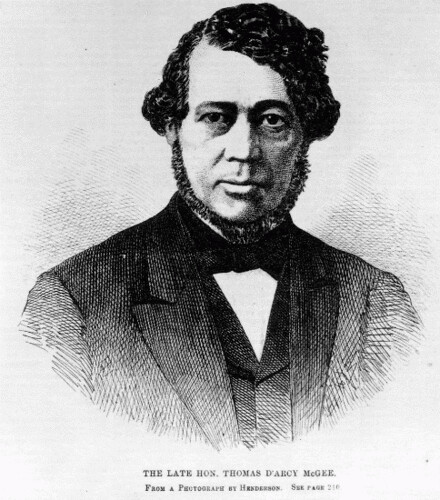
  2. Darcy McGee
  3. Confederation
  4. Fenians
  5. British North America Act
  6. Another topic to be approved by Mrs. Hayashi.

Confederation Part Two - Refer to These Notes for your Confederation Project

  • September 1864, in Charlottetown, P.E.I. and then again later in Ottawa, representatives met to discuss possible confederation of British North America.
  •  Politicians such as John A. Macdonald, George Cartier, Darcy McGee, Samuel Leonard Tilley,  Charles Tupper, William McDougall, George Brown, and many others met in Charlottetown to negotiate the terms of Confederation.
  • In between meetings, there were Grand Balls and concerts to attend, but John A. Macdonald stayed up late every night writing the clauses for the agreement.
  • Macdonald tries to place Ottawa at the centre of everything.
  • Once presented, the Maritimers, particularly PEI, were uncomfortable with the agreement.  They had hoped to have help buying out the absentee landlords.
  • Nova Scotia was afraid Ottawa is becoming too powerful.
  • New Brunswick was concerned Ottawa will take all the public lands.
  • When it looked as though the Maritimers would scuttle the deal, some Canadian raiders robbed a bank on the US side.
  • A US newspaper called for the US to invade Canada
  • Because of the fear of US invasion, the politicians put aside their complaints and came to the carefully and legalistically worded agreement with a focus on "Peace, order and good government"..
  • The agreement was then taken back to the provinces.
  • Queen Victoria chose Ottawa to be the nation's capital.
  • English Canada supported the agreement but the French didn't.
  • Wilfred Laurier led the opposition to Confederation in French Canada.
  • The "Rouge Party" visited communities to encourage people not to support Confederation however they didn't offer an alternative.
  • The Church told parishioners not to support anti-Confederationists.
  • The vote in government was definitely pro-confederation and in the next election, the people re-elected the pro-Confederation politicians.
  • The Maritime provinces were enjoying an economic boom because of their trade with Britain and the US Civil War - they rarely did business with Montreal.
  • New Brunswick voted in an anti-Confederationist government and voted out Tilley as premier.
  • The British government wanted pro-Confederation governments in Canada and the Grand Trunk Railway financially supported Tilley which allowed him to return to power.


  • In Nova Scotia Charles Tupper returned from the conferences hoping that the government would accept Confederation but Joseph Howe wrote a number of articles and letters for the newspaper against Confederation.
  •  April 1865 Lincoln was assassinated in the US causing instability.
  • The Fenian brotherhood, a group of Irish Americans whose goal was to drive the British out of Ireland and to attack the British in Canada, planned to invade Canada.
  • The Fenians raided the border of New Brunswick off an on for months.
  • Because of fear around the Fenian raids, the pro-Confederationists gained power and momentum.
  • The Maritimes turned pro-Confederation with the exception of PEI which entered in Confederation in 1873 and Newfoundland which entered in Confederation in 1949.
  • George Cartier and John A. Macdonald traveled to London with delegates from the provinces.
  • While in London, John A. Macdonald made Agnes Barnard his second wife.
  • The British Parliament was heading for an election so Lord Carnarvon pushed the British North America Act through.  
  • On March 29, 1867, Queen Victoria signs the BNA Act into power.
Queen Victoria

Fathers of Confederation


  • July 1, 1867, Canada celebrated its first Dominion Day and first day as a country.  
  • Sir John A. Macdonald was named the first prime minister of Canada.
  • The whole country celebrated.


  • Canada now consists of Ontario, Quebec, Nova Scotia, and New Brunswick.


      Tuesday, November 16, 2010

      Confederation Part One - Refer to These Notes for your Confederation Project


        • The Civil War had broken out in the US.
        • There were only 4 million people in all of the Canadian colonies.
        • Because the British seemed to be siding with the South, there was fear that the war might spread to Canada.
        • the British North Americans signed up to the reserve forces in droves.
        • Two important players in Confederation were George Etienne Cartier and John A. Macdonald.

        • Cartier had been a rebel in the Rebellions of 1837 and had fled to the US
        • He returned to Lower Canada after pledging allegiance to Britain.
        • He worked tirelessly as a politician to support French Canada by building schools, hospitals, etc.

        •  John A. Macdonald was born in Scotland but came to Canada at age 5 which made him feel far more Canadian than he did Scottish.
        • His first wife was very ill and after she died he disappeared from public life only to return to politics later.
        • He was an extremely clever man and a genius at political affairs.
        • In the 1850s Cartier and Macdonald become political allies because they had similar goals.
        • Both wanted a transcontinental railway and both wanted to join the colonies to create a united British North America.
        • George Brown came to Canada at age 25 and started the Globe newspaper.
        • He printed many letters and articles against Macdonald and Cartier and the idea of the union of the colonies.
        • The British government created a voting system in which each of the two colonies, Upper and Lower Canada, had an equal number of seats in the colonial governments.  Initially Lower Canada had a greater population so this was designed to weaken the French vote.
        • Later, this backfired as the population of Upper Canada passed that of Lower Canada.
        • George Brown started the Grit political party - his platform was to get representation by population.
        • Cartier did not want to change to representation by population as it was not in favour of the French who by this time had a smaller population.
        • This led to a political crisis in Canada in 1862.
        • At the same time that Canadian politics were in crisis, the military situation was also in crisis.
        Social Situation in Quebec
        • In spite of the crises in the Canadian colonies and in the US, immigrants kept flowing in.
          In the mid 1800s in the Canadian colonies, most people married in their 20s
        •  In marriage, men promised to support their families and women promised to honour and obey their husbands.
        • Women had no more legal rights than children did.
        • In the 1850s escaped slaves flooded over the border from the US (see previous pages).
        • Anti-slavery societies sprang up to help, however some people demanded an end to black immigration. 
        • In spite of that, black communities began to grow in the Maritimes, in Upper Canada, and in places like Victoria.
        • In Victoria, a black military regiment was formed to protect British North America.
        • Irish potato famine (see previous pages) brought many Irish poor - malnourished and ill with typhus.

        • Many children arrived in Quebec orphaned by typhus.  Lots of these children where adopted into Quebec families which is why there are so many francophones with Irish last names today.
        • Winter in Quebec was hardest on poor - there was little work
        • The Grey Nuns tried to support the poor, particularly abandoned infants.
        • Some years the Nuns had more than 700 infants left on their doorstep with only 33 surviving the year.
        • Some of the Irish immigrants formed "Young Ireland" with their purpose being to free Ireland from England - Thomas Darcy McGee was the leader of the movement.

        • The British government  suppressed the Young Ireland movement and put out a warrant for McGee.
        • McGee fled to New York where the Irish were hated and had few opportunities.
        • McGee was given the opportunity to start a newspaper in Montreal so he returned to Canada where he was also elected to government.
        • The other newspaper man, George Brown, travelled on holidays to England and met and married his wife - Ann Nelson Brown.
        • He also studied British parliament where it becomes clear that the British government is tired of managing Canada.  
        • On his return he called for the uniting of Canada (a complete change of opinion).
        • Macdonald and Cartier offer an olive branch to Brown and include him in their plans.
        • French critics warn Cartier to be careful, however they still form a coalition between the three men.
        • Brown calls for all of Canada to be joined from east to west coast.
        • All politicians become fired up by the idea including Darcy McGee.
        William Notman - photographer
         Photography of Sir John A. Macdonald by William Notman.
        • William Notman fled bankruptcy in Scotland and came to Canada.
        • Wanting to start all over again, he began to use a new device called a "camera".
        • He became famous for his camera techniques and took pictures of many famous people including John A. Macdonald and Cartier.
        • He became very successful but not all immigrants enjoyed the same success.
        • There were many social problems in the Canadian colonies.
        • Rum became cheaper than clean water.
        • Sometimes rum was given away free in stores as an incentive to shop there.
        • In New Brunswick, Samuel Leonard Tilley, the son of a pharmacist from Gagetown and a complete teetotaller, rode the temperance movement into power.
        • In 1855, Tilley introduced a bill to prohibit liquor, upon which he blamed all social evils. To everyone's surprise, it passed the legislature, no one having the courage to oppose it.  This brought the colony of New Brunswick close to civil war!

        • As with Britain, factories began to spring up.
        • All who applied are hired, both old and young.
        • New workers are expected to work unpaid for the first couple of months, after which they are paid very little and are frequently beaten with their pay being docked for indiscretions such as glancing to the side.


        Info from: Canada: A People's History


              Tuesday, November 9, 2010

              The Indian Act of 1876 Part 2

              The Indian Act is a legal document and a set of laws that was passed by the Canadian government in 1876 that is still enforced today. This set of laws gave the government total control over the lives of the Indigenous people of Canada - it made Indigenous people wards of the state.
               
              Historically, the British government had taken control over the Indigenous people.  Once Canada became a country, the responsibility was then passed on to the Canadian government.  Once the fur trade ended the Indigenous people had no role to play in settlement.  In fact, they were seen as a barrier to the government plans to the settlement of Western Canada.   The government referred to this as the "Indian Problem".

              The government's response to this "problem" was to create the Indian Act.  The objectives to the Indian Act were to have control over the Indigenous people and to assimilate the Indigenous people into the dominant white culture.  In order to do this, the Indian Act gave the government complete control over Aboriginal politics, culture, education, and personal lives.  Indigenous peoples were not allowed to leave reserves, not allowed to own land, or not allowed to do business.  Also, the government decided who would be a "status Indian" and who would not.  Children were removed from families and placed into residential schools.  Financial control of Indigenous peoples were given to the federal government.  Aboriginal people were not given the vote until 1960.  The potlatch was banned in the 1880s and the sundance was banned until 1951.  It also banned fundraising for land claims support from 1921 - 1958.  The government established control over wills and burials.  All farming and trading businesses were controlled by the government.  Also, the government hired Indian agents to enforce the Indian Act.

              While there are many negative aspects to the Indian Act, there are some positive aspects too.  The Indian Act is the only government document that exists that recognizes Aboriginal peoples.  Without the Indian Act, Indigenous people would not have any special status in terms of health services, education, subsidized housing, and exemptions from certain taxes.

              Some amendments to the Indian Act have been made in either 1951 or 1985 including lifting the ban on ceremonies and fundraising, returning status to certain non status Aboriginal women and their children.  In spite of the amendments, much of the control of the Indigenous peoples remains with the government through the Indian Act.

              (From Shared Learnings: Integrating BC Aboriginal Content K-10)

              Using the pages "The Indian Act Part 1 & 2", fill out the handout "The Indian Act : An Introduction".

              Sunday, November 7, 2010

              The Indian Act of 1876 Part 1

              The Indian Act, 1876 In 1876 the new government of Canada passed the Indian Act which changed and pulled together all previous laws concerning the Indigenous people of Canada. Notably, this act turned the Aboriginals into legal wards of the state. 


              Definition: In law, a ward of the state is someone placed under the protection of a legal guardian, in this case the government. A court may take responsibility for the legal protection of an individual, usually either a child or incapacitated person.  


              Question: What attitudes do you think the government held about the Indigenous people of Canada?


              The Indian Act also defined what the government considered to be an "Indian".  For example:


              • Any woman that married an Aboriginal man could be considered an Indian and could be allowed to live and even be buried on a reserve. These women also received other cultural and social benefits by gaining Indian status. However, any Aboriginal woman who married a white, European male was now considered to be a bona fide member of Canadian society. She lost her Indian status and every right that came with it.
              • All "half-breed" Indians, like the Metis, were not entitled to Indian status. This included Métis who had received scrip - transferable land or cash allowances that were issued on paper certificates. (from http://www1.canadiana.org/citm/themes/aboriginals/aboriginals8_e.html)
              Even Sir John A. Macdonald, the first Prime Minister of Canada, said "If they are half-breed, they are [considered by the government to be] white."


              Read what Alexander Morris recommended regarding "half breeds". Click here.


              Questions:  Why is the term "half breed" so offensive?  What type of thinking does it indicate the early leaders of Canada held about the Metis?
              What do you think about the government defining what made one person a "status Indian" and another not?  Is this still a concern today?  What do you think?
              Look at the first example given about women and their status.  Many people consider there are a number of problems with this thinking.  What would you consider the problems to be?  When would you guess this part of the Indian Act was changed?


              The Indian Act also created rules about the sale of Aboriginal lands. The government could issue licenses allowing timber to be cut and removed from these properties. In other world, the Indigenous peoples were given lands to live on but did not have control over the resources on the lands.

              As of 1876, there were legal punishments for Indigenous peoples who left reserves or sold liquor on reserves.  Following the 1876 Indian Act, Aboriginals who lived on reserves were forced to carry an identity card, like a passport, every time they stepped off reserve land.
              The act was rewritten in 1951 and revised again in 1985. However, many provisions - including ones prohibiting Aboriginals from living on land outside of reserves or from drinking - have since been repealed or have simply fallen into disuse.

              (from http://www1.canadiana.org/citm/themes/aboriginals/aboriginals8_e.html)


              Canada's Indigenous People in the 1800s


              As settlers spread further into the colonies, the original people of the Eastern Woodlands were pushed out of their traditional territories.  They were placed in "reserves", usually on the edges of settled land and forgotten unless the settlers wanted something from them, i.e. land or labour.  Many of the Indigenous people of Canada were forced to adapt to the European way of doing things.  

              • Algonkians changed from hunting and fishing to gardening and shopping at settlement stores
              • Ojibwa resisted the push into farming
              • The Mohawk and other Iroquoian peoples had long been farmers and had established their own governments so were able to adapt more easily to deal with officials, merchants and speculators
              Land claim disputes between the dominant government and the Indigenous peoples go back to the 1800s. By the mid 1800s, the Ojibwa of Lake Superior were battling with the government over miners who were trespassing on their land.  This occurred because the government had given several mining companies the right to explore the land in that area in 1845 and later even funded the exploration.  Even though the government found in favour of the Ojibwa, they did not stop the mining and exploration from occurring.

              Settlers also pressured the First Nations of that area to sell their best land and would sometimes challenge previously signed and agreed upon treaties.  Also, the government pressured bands and communities to rent out their best land and would pay an annual fee in return for land it would sell to settlers.  Because many of the First Nations people were extremely poor it was difficult for them to hold out to such pressure.  The problem came, of course, after they had sold or rented their best land, they would not be able to farm or hunt as well as they had before.

              There was tremendous pressure on the Indigenous peoples to assimilate into White society, however Elders struggled to maintain traditions and oral histories.

              (From Horizons: Canada Moves West pp 57-59)

              Write a paragraph answering questions 2a&b from page 59 in your textbook.

              Thursday, November 4, 2010

              Upper and Lower Canada Test

              What: Test

              When: Mon., November 8th

              What the heck do I need to study?  
              • Lord Durham's Report, The Rebellions of 1837, 
              • William Lyon Mackenzie and Louis-Joseph Papineau, 
              • The Family Compact and the Family Clique, 
              • Women's Roles in Upper Canada, and 
              • vocabulary and definitions.